
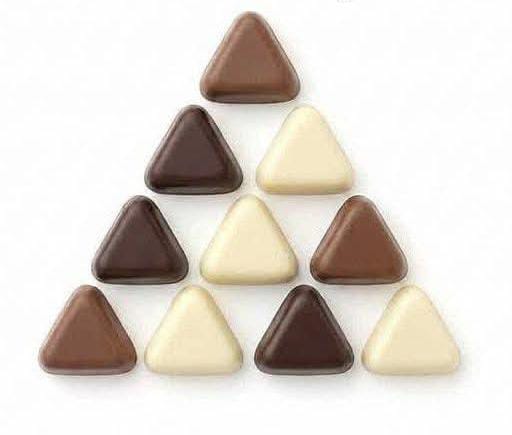
How Many Triangles Do You See?
A Simple Puzzle That Reveals More About Your Brain Than You Think
At first glance, the image looks simple. Just a neat arrangement of triangle-shaped pieces stacked together in different shades. Clean lines. Clear structure. Nothing confusing.
But then you read the question:
How many triangles do you see?
Suddenly, what felt obvious becomes surprisingly difficult.
You start counting.
One. Two. Three.
You pause.
You count again.
Did you miss one?
Did you count something twice?
Are there hidden triangles you didn’t notice at first?
That’s when this playful visual puzzle turns into a real brain teaser.
Why This Triangle Puzzle Is Harder Than It Looks
The reason this puzzle confuses so many people is simple:
Our brains are wired to recognize large, obvious shapes first.
We naturally notice:
- The small individual triangles
- The clear outlines
- The most visible structures
But what we often miss are:
- Medium-sized triangles formed by combining smaller ones
- Large triangles made from multiple smaller sections
- Overlapping or hidden triangular patterns
- The full outer shape (which might also be a triangle)
This layered structure makes the puzzle much more complex than it appears.
The Psychology Behind Counting Triangles
This puzzle isn’t just about shapes. It’s about perception.
When you look at the image, your brain processes visual information in stages:
- Pattern recognition – spotting obvious shapes
- Structural grouping – combining smaller shapes into larger ones
- Detail scanning – searching for hidden or subtle patterns
Some people stop at step one.
Others go deeper.
That’s why different people get different answers — even when looking at the exact same image.
What Your Answer Might Say About You
Believe it or not, how you approach this puzzle can reveal interesting things about your thinking style.
If you answered quickly
You likely trust your first instinct and rely on surface-level perception.
If you carefully recounted multiple times
You probably have strong analytical thinking skills and attention to detail.
If you doubted your answer
You might be naturally skeptical and open to reconsidering your assumptions.
If you found more triangles after reviewing
You likely enjoy problem-solving and digging deeper.
There’s no “personality test” here — but puzzles like this highlight how differently we observe the same reality.
How to Count the Triangles Correctly
If you want to solve this properly, try this structured method:
Step 1: Count the Smallest Triangles
Start with the most obvious, individual shapes.
Step 2: Look for Combined Triangles
Check if two or more small triangles form a larger one.
Step 3: Identify Medium-Sized Triangles
Scan for shapes created from three or four smaller pieces.
Step 4: Look at the Entire Structure
Does the full image itself form one large triangle?
Step 5: Recount Slowly
Our brains often miss shapes on the first scan.
Pro tip: Sometimes slightly squinting or zooming out helps you see the larger formations.
Why People Disagree on the Answer
If you search online, you’ll notice something interesting:
Different people give different numbers.
Why?
Because:
- Some count only fully outlined triangles
- Others count overlapping or implied triangles
- Some double-count without realizing
- Others miss hidden combinations
The puzzle becomes a test of definition as much as observation.
So the “correct” answer depends on the rules you apply.
Why Triangle Puzzles Go Viral
You’ve probably seen similar puzzles on social media:
- “How many squares do you see?”
- “Can you find the hidden shapes?”
- “Only 1% of people get this right!”
They spread quickly because they trigger curiosity.
Your brain wants closure.
When faced with a question like this, it feels incomplete until it finds an answer.
That curiosity keeps people engaged — counting, recounting, and sharing.
The Deeper Lesson Behind the Puzzle
This puzzle reflects something bigger than geometry.
In life, we often assume we see the full picture at first glance.
But just like the triangles:
- There may be hidden layers
- Larger patterns built from small details
- Structures we only notice when we step back
Perspective changes everything.
Sometimes the difference between 12 triangles and 18 triangles isn’t the image — it’s how carefully you look.
Final Challenge
Now it’s your turn.
Take another look at the image.
Count carefully.
Slowly.
Methodically.
How many triangles do you see?
And before checking anyone else’s answer — ask yourself:
Are you sure you didn’t miss one?